Compare your options
Roll-on joint gel with a massage roller: how it compares to creams, patches and pills
Four ways to deal with achy joints, side by side, and what a roller adds that the others leave out.

We earn a commission if you buy through the links on this page. It doesn't change your price, and it doesn't change what we tell you.
If you're comparing options for achy joints, you've probably run into four kinds: rubs and creams, patches and heat wraps, pain pills, and the newer roll-on gels with a massage roller built in. They're not competing for the same job, so here's a plain side-by-side.
| Creams and rubs | Patches and heat wraps | Pain pills | Roller + gel | |
|---|---|---|---|---|
| Hands stay clean | No | Yes | Yes | Yes |
| Reaches lower back and shoulder blades alone | Hard | Hard to place | Not applicable | Yes, the head turns 360° |
| Massage included | Only if you rub | No | No | Yes, five rolling balls |
| Smell | Often strong | Varies | None | Light |
| Where it acts | Where applied | Where applied | Whole body | Where applied |
Pills have their place, and your doctor is the right person to weigh them for you. The roller's contribution is massage you can give yourself several times a day, without bending.
Why the massage part matters
Of all the hands-on approaches for knee osteoarthritis, massage is one of the better studied. Researchers who tested different doses found that one hour per week was the sweet spot, with people reporting less pain and stiffness by week eight (Perlman, 2012). Most of us can't book that every week. A roller gives you short, frequent sessions at home.
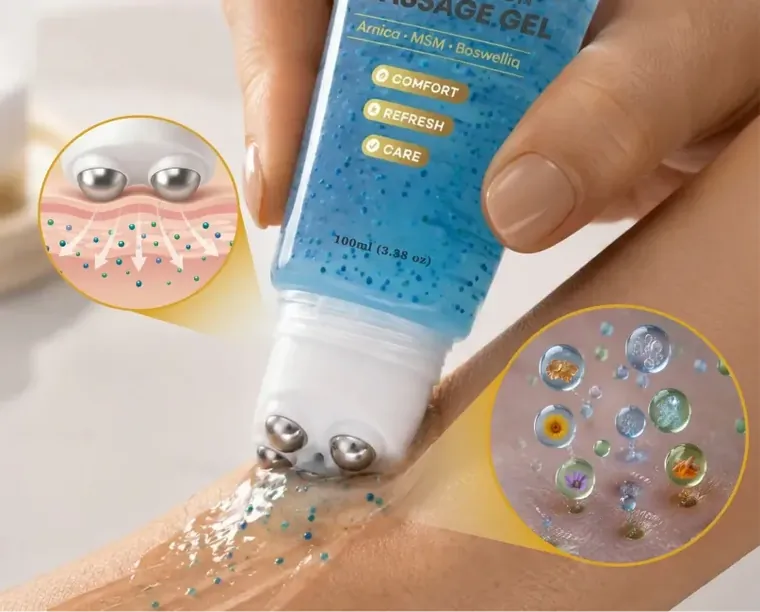
What's in the gel
The headline ingredients are arnica, Boswellia, MSM, magnesium and turmeric, with menthol for the cool feeling. Arnica is the one with a head-to-head test on the skin: in a three-week trial for arthritis of the hands, arnica gel held its own against ibuprofen gel (Widrig, 2007). Boswellia, turmeric and MSM have encouraging studies too, though mostly in capsule form. The full table, with a line on each, is in the complete review.
And the magnets?
Honest answer: the evidence is thin. When researchers pooled the controlled studies on static magnets, pain scores didn't come out clearly better than with fake magnets (Pittler, 2007). I'd buy it for the massage and the gel. If the magnetic field adds something for you, consider it extra.
How to use a roller gel well
- Start on clean, dry skin over the joint or muscle.
- Roll slowly in small circles for a minute or two and let the balls do the pressing.
- Go easy on a very sore joint. The man in our story found the first days uncomfortable on his knees, so start with light pressure.
- Wait for it to soak in before you pull clothes over it.
- Repeat through the day. Two to four sessions daily is the range on the official page; three worked for him.
What happened when a 58-year-old switched to one
At 58, with both knees bad, he'd been relying on strong pain pills that, as he saw it, only quieted things for a while. He picked the roller because he'd never seen a gel with massage balls before. Nine slow days later, on day 10, the clicking stopped and his mornings got easier. On day 15 he was kneeling in his garden again. Now he's on the subscription, uses less, and exercises. Every body responds differently.
Roller tube or plain gel jar?
The same company also sells the gel on its own in a 75 ml jar that you apply by hand. If bending or rubbing is the problem, the roller is the one to get. If you like massaging with your fingers, the jar is simpler.
Safety in one paragraph
External use only. Because the balls are magnets, leave it alone if anything electronic is implanted in your body, such as a pacemaker, defibrillator, hearing implant or insulin pump. Skip broken or irritated skin, stop if the skin reacts, and ask your doctor or pharmacist first if you take prescription medicines or are pregnant. More detail is in the complete review.
See the roller on the maker's storePrices shown in your currency